
How AI Learns
Lesson Summary:
In this lesson we’ll peek behind the silicon curtain to watch algorithms practice, stumble, and finally get it right. You’ll learn how supervised, unsupervised, and reinforcement learning each coax insight from oceans of data—and why that matters to everything from selfie filters to Google Translate. By the end, you’ll be able to explain the magic without hand-waving.
The Data Waltz: Why Pattern-Finding Matters
It all begins with an idea. Maybe you want to launch a business. Maybe you want to turn a hobby into something more. Or maybe you have a creative project to share with the world.
Your phone spots friends in photos. Spotify finishes your sentence in song recommendations. None of this happens by accident—it’s the result of machine learning dancing with data.
Pattern Detection: Algorithms look for repeating shapes, words, or moves.
Feedback Loops: Good guesses get rewarded; bad ones get tweaked.
Real-world Impact: Image recognition saves time—translation dissolves language walls.
Ready to see how the choreography works? Let’s zoom in on three training styles.
-
Think of flashcards: every data point (image, sentence) is tagged with the correct answer. The model studies these pairs until it can predict labels on its own. Used in email spam filters, medical imaging, and credit-risk scoring.
-
No answer key provided. Algorithms group data by similarity: customer segmentation, topic modeling, anomaly detection.
-
Like training a pet. The agent performs an action, gets a score, and updates its strategy—perfect for game-playing AIs, robotics, and ad-placement bidding.
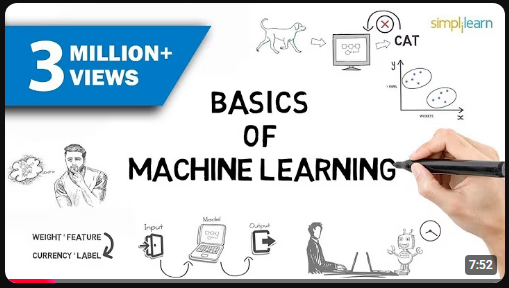
Introduction To Machine Learning Simplilearn (2024)

-
Goodfellow, I., Bengio, Y., & Courville, A. (2016). Deep Learning. MIT Press. Publisher link
Russell, S., & Norvig, P. (2021). Artificial Intelligence: A Modern Approach (4th ed.). Pearson. Publisher link
Sutton, R. S., & Barto, A. G. (2018). Reinforcement Learning: An Introduction (2nd ed.). MIT Press. Publisher link